Logarithmic and Hyperbolic Structures in Mathematics and Their Conceptual Analogies in Physics
DOI:
https://doi.org/10.55672/hij2026pp19-24Keywords:
logarithmic integral, asymptotic behavior, mathematical physics, relativistic structures, singularitiesAbstract
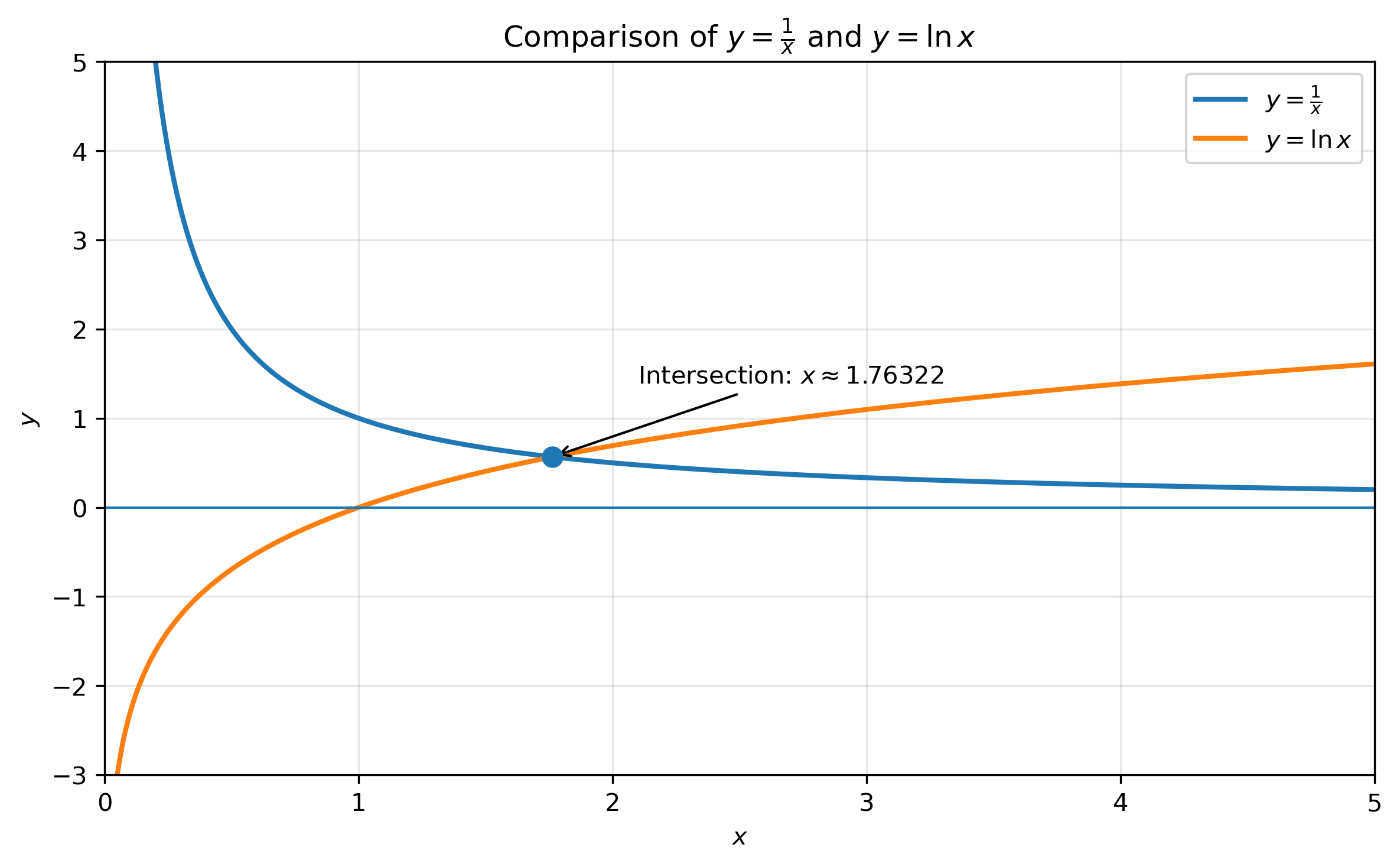
The inverse function occupies a special position in elementary calculus because the standard power-law rule for integration fails for a particular exponent. This exceptional behavior motivates a broader investigation into the mathematical structure of logarithmic and hyperbolic functions. In this article we examine the asymptotic behavior of logarithmic and inverse functions, with particular emphasis on singularities, asymptotes, and intersection structure. We investigate how logarithmic behavior naturally emerges from inverse power relationships and discuss the geometric significance of the transition between these two classes of functions. The discussion is then extended toward conceptual analogies in physics, especially in relation to asymptotic behavior appearing in special relativity and gravitational theory. Rather than proposing modifications to established physical theories, the article explores mathematical parallels between divergent structures, limiting processes, and physical interpretation. The aim of this work is therefore not to replace existing physical theories, but to highlight mathematical patterns that recur in both analysis and theoretical physics.
Downloads
References
[1] Stewart, J. (2015). Calculus: Early Transcendentals (8th ed.). Cengage Learning.
[2] Apostol, T. M. (1967). Calculus, Volume 1. Wiley.
[3] Courant, R., & John, F. (1999). Introduction to Calculus and Analysis, Volume 1. Springer.
[4] Arfken, G. B., Weber, H. J., & Harris, F. E. (2013). Mathematical Methods for Physicists (7th ed.). Academic Press.
[5] Bender, C. M., & Orszag, S. A. (1999). Advanced Mathematical Methods for Scientists and Engineers. Springer.
[6] Einstein, A. (1905). On the electrodynamics of moving bodies. Annalen der Physik, 17, 891–921.
[7] Einstein, A. (1916). The foundation of the general theory of relativity. Annalen der Physik, 49, 769–822.
[8] Corless, R. M., Gonnet, G. H., Hare, D. E. G., Jeffrey, D. J., & Knuth, D. E. (1996). On the Lambert W function. Advances in Computational Mathematics, 5, 329–359.
[9] Farmer, J. R., & Musakhail, M. A. (2026). An exploratory framework for gravitation and electrodynamics: A Lagrangian-Hamiltonian perspective. Hyperscience International Journal (HIJ), 1–12. https://doi.org/10.55672/hij2026pp1-12
[10] Farmer, J. R., & Musakhail, M. A. (2026). Lagrangian dynamics of the Musakhail Aether Dynamical Lagrangian. Hyperscience International Journal (HIJ), 13–18. https://doi.org/10.55672/hij2026pp13-18
[11] Schutz, B. (2009). A First Course in General Relativity (2nd ed.). Cambridge University Press (2008)
Published
How to Cite
Issue
Section
License
Copyright (c) 2026 Hyperscience International Journal

This work is licensed under a Creative Commons Attribution-NonCommercial 4.0 International License.





 Google Scholar
  Crossref
  Scopus
  WorldCat
  ORCID
ORCID  Scilit
  Mendeley
  Internet Archive
  Dimensions
  Cambridge