An Exploratory Framework for Gravitation and Electrodynamics: A Lagrangian-Hamiltonian Perspective
DOI:
https://doi.org/10.55672/hij2026pp1-12Keywords:
Lagrangian-Hamiltonian duality, force-based gravitation, electromagnetic four-vectors, helical flux-tube dynamicsAbstract
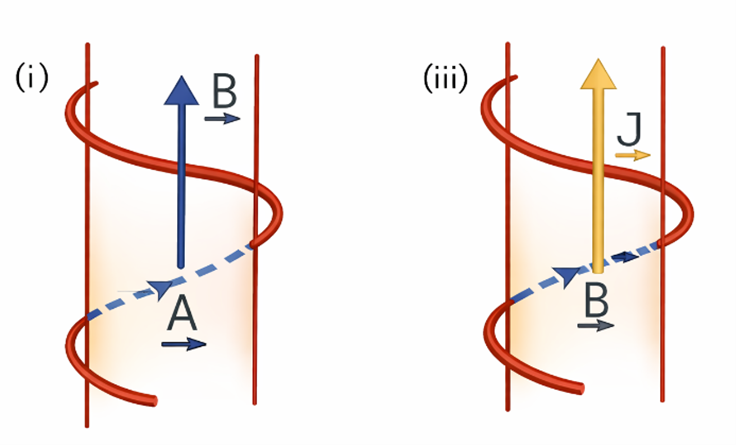
This paper presents an exploratory, force-based framework for gravitation and electrodynamics, motivated by a correspondence between Musakhail's aether dynamics and Einsteinian special relativity. These two perspectives are interpreted through the lens of Lagrangian-Hamiltonian duality, wherein force-based formulations (Lagrangian) and energy-based formulations (Hamiltonian) are treated as complementary descriptions of underlying physical dynamics. The aims of this work are threefold. First, to develop a force-based interpretation of gravitational interactions by examining Musakhail's force relation, F=c^2 (m-m_0 ) in parallel with the relativistic energy expression, E^2=(pc)^2+(m_0 c^2 )^2 highlighting their dual structure. Second, to introduce and analyze two exploratory electromagnetic four-vectors (J·E,E×B) and (ħω,v×B) employing an extremization principle as a heuristic tool for investigating structural analogies between dissipation, Poynting flux, and Lorentz-force dynamics. Third, to explore a minimal-scale electro-gravitational correspondence through helical flux-tube geometries and a constant-mass acceleration mechanism, suggesting possible shared features between fermionic transport and electromagnetic field configurations. The extremization procedure, in which the scalar component of a four-vector is set equal to the magnitude of its vector component, is applied heuristically to reveal formal parallels rather than to derive rigorous field equations. Within this phenomenological model, gravitational interactions are considered as collective nuclear-scale force processes, while electromagnetic energy transport is examined through Lorentz-force cancellation and Poynting-flow relations. The helical flux-tube structures provide a unifying geometric motif, with effective tension identified with Newtonian gravitational force. This work is intended as a conceptual and phenomenological exploration rather than a replacement for established relativistic field theories. Its physical relevance depends on further mathematical development and empirical validation. Several qualitative, testable consequences are outlined to motivate future theoretical refinement and experimental assessment.
Downloads
References
[1] Farmer, J. R. PhD Thesis – Aether Dynamics and Electrodynamics of Solar Flares. Amazon (Self-published).
[2] Goldstein, H. Classical Mechanics. 3rd ed., Addison-Wesley, 2002.
[3] Einstein, A. "On the Electrodynamics of Moving Bodies." Annalen der Physik, 1905.
[4] Griffiths, D. J. Introduction to Electrodynamics. 4th ed., Cambridge University Press, 2017.
[5] Jackson, J. D. Classical Electrodynamics. 3rd ed., Wiley, 1998.
[6] Farmer, J. R. Grand Unification of the Four Fundamental Forces of Physics. Amazon (Self-published).
[7] Pirani, F. A. E., and Schild, A. "On the Quantization of Einstein's Gravitational Field Equations." Physical Review, vol. 79, pp. 986-991, 1950.
[8] DeWitt, B. S. "Point Transformations in Quantum Mechanics." Physical Review, vol. 85, pp. 653-661, 1952.
[9] Farmer, J. R. Quantum Theory of Electrodynamics. Amazon (Self-published).
[10] Bellan, P. M. "Dynamic, Astrophysically- and Solar-Relevant MHD Plasma Experiments." Princeton Center for Heliophysics Seminar, 2021.
[11] Farmer, J. R. A Saucerful of Science. 2nd ed., Amazon (Self-published).
[12] Ejection of Plasma Toroids from Twisted Flux Tubes in Astrophysics." PROTO-SPHERA Project, ENEA, Italy.
[13] Farmer, J. R. Autobiography of James Russell Fields. Amazon (Self-published).
[14] Dirac, P. A. M. "The Quantum Theory of the Electron." Proceedings of the Royal Society A, vol. 117, pp. 610-624, 1928.
[15] Parker, E. N. "The Dynamical State of the Interstellar Gas and Field." Astrophysical Journal, vol. 145, pp. 811-833, 1966
Published
How to Cite
Issue
Section
License
Copyright (c) 2026 Hyperscience International Journal

This work is licensed under a Creative Commons Attribution-NonCommercial 4.0 International License.





 Google Scholar
  Crossref
  Scopus
  WorldCat
  ORCID
ORCID  Scilit
  Mendeley
  Internet Archive
  Dimensions
  Cambridge