Lagrangian Dynamics of the Musakhail Aether Dynamical Lagrangian
DOI:
https://doi.org/10.55672/hij2026pp13-18Keywords:
Lagrangian dynamics, force-based gravitation, Reverse Higgs process, electromagnetic four-vector formalismAbstract
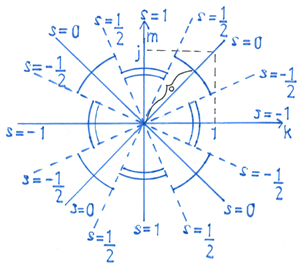
This work extends previous investigations into the relationship between the Einsteinian Hamiltonian formulation and the Musakhail aether-based Lagrangian description of dynamics. While earlier studies established their simultaneous role in the Newtonian-Einsteinian framework, the present paper focuses specifically on a formal Lagrangian dynamical analysis in order to derive the corresponding equation of motion. Within the proposed framework, the resulting dynamics suggest a correspondence in which the classical relation F=ma transitions naturally toward the relativistic energy expression E=mc^2, interpreted here through the restoration of Newtonian behavior during the so-called Reverse Higgs process. In this regime, the effective mass remains constant (m=m_e ) rather than velocity-dependent, permitting a force-based description of particle-wave interaction. The analysis further introduces a rotating Einstein energy vector derived from the invariant relation E^2=(pc)^2+(m_0 c^2 )^2, which is employed to describe the cyclic interaction between fermionic constituents and electromagnetic wave structure. This approach yields a dual interpretative framework in which either photon energy extraction or spin measurement may occur, depending on the observational configuration. The formalism also explores a complex representation in which the orthogonal axis is treated as imaginary, producing a geometrical interpretation associated with oscillatory spin states of fermions (±1/2) and photons (0,±1). The resulting model suggests an underlying symmetry between fermionic and bosonic spin states within the proposed aether-dynamical environment, providing a phenomenological bridge between classical force dynamics and relativistic energy relations.
Downloads
References
[1] Goldstein, H., Poole, C., & Safko, J. Classical Mechanics, 3rd ed.,Addison-Wesley (2002).
[2] Landau, L. D., & Lifshitz, E. M. Mechanics, 3rd ed., Butterworth-Heinemann (1976).
[3] Lanczos, C. The Variational Principles of Mechanics, Dover (1986).
[4] Farmer, J. R. Aether Dynamics and Electrodynamics of Solar Flares, PhD Thesis.
[5] Farmer, J. R., & Musakhail, M. A. "Re-visiting Musakhail's Aether Dynamics-Introducing Lagrangians and Hamiltonians," https://doi.org/10.55672/hij2026pp01-12.
[6] Misner, C. W., Thorne, K. S., & Wheeler, J. A. Gravitation, W.H. Freeman (1973).
[7] Einstein, A. "On the Electrodynamics of Moving Bodies," Annalen der Physik, 17, 891-921 (1905).
[8] Peskin, M. E., & Schroeder, D. V. An Introduction to Quantum Field Theory, Addison-Wesley (1995).
[9] Gri_ths, D. J. Introduction to Elementary Particles, Wiley (2008).
Published
How to Cite
Issue
Section
License
Copyright (c) 2026 Hyperscience International Journal

This work is licensed under a Creative Commons Attribution-NonCommercial 4.0 International License.





 Google Scholar
  Crossref
  Scopus
  WorldCat
  ORCID
ORCID  Scilit
  Mendeley
  Internet Archive
  Dimensions
  Cambridge