The Overlap Is Not the Bond: A Set-Theoretic and Probabilistic Framework for Marriage, Family Structure, and Divorce
DOI:
https://doi.org/10.55672/hpss2026pp24-38Keywords:
set theory, marriage, family systems, divorce, probability tree, path-dependence, complex systems, active marital bond, Jaccard similarity, theoretical modelAbstract
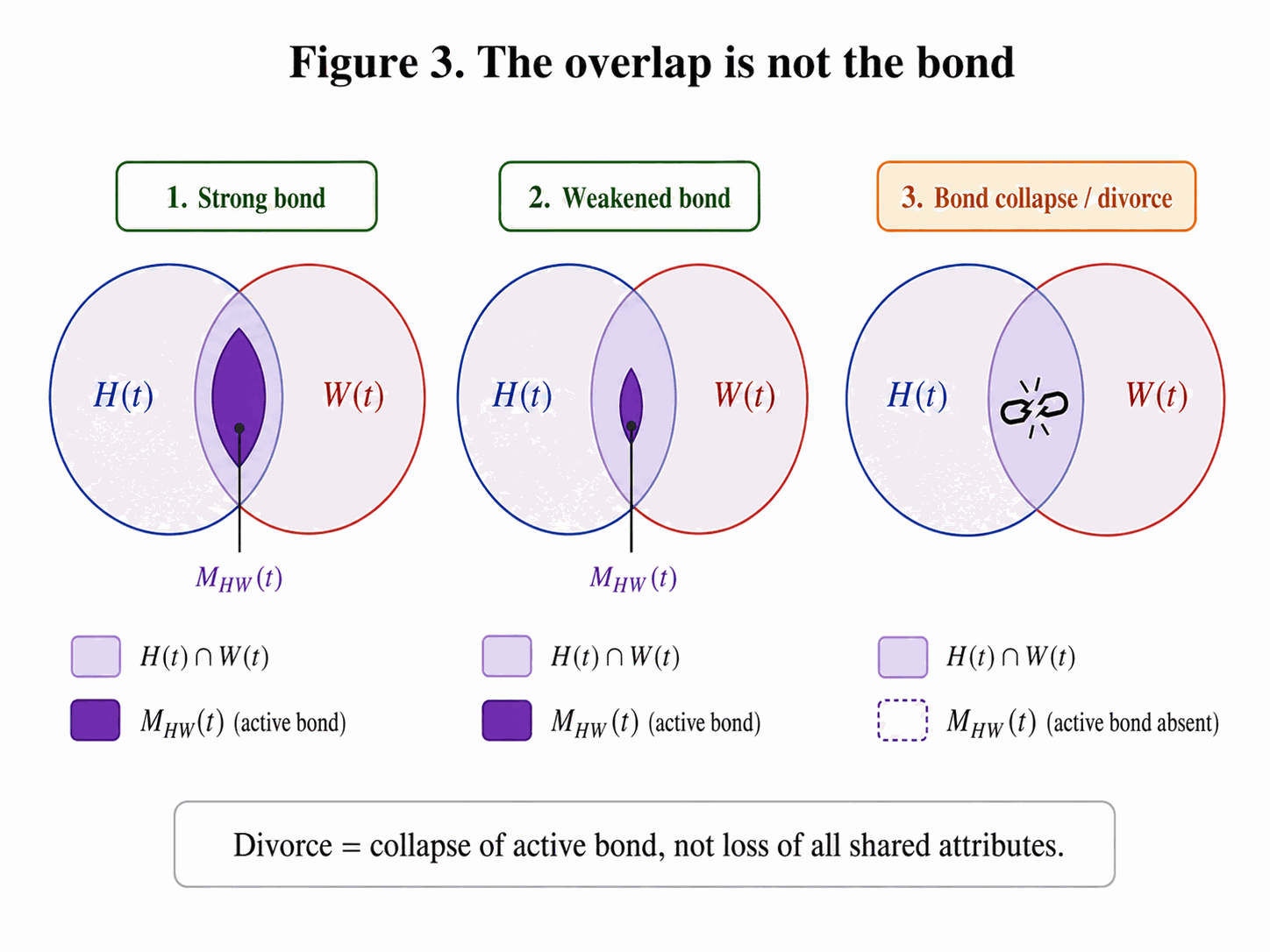
This article develops a theoretical and conceptual mathematical framework for representing marriage, family structure, and divorce. The framework combines set-theoretic representation, normalized similarity measures, active-bond dynamics, probability trees, and ideas from complex systems. Each person is modeled as a time-dependent attribute structure embedded in a universal attribute space. The central modeling assumption is a non-identity principle: within a sufficiently rich description, two distinct persons are represented by non-identical identity structures. Interpersonal closeness is therefore not defined by complete equality, but by normalized overlap measures such as the Jaccard index and, in a more general formulation, by weighted or fuzzy similarity measures. Marriage is modeled not merely as the intersection of two person-sets, but as an active marital-bond structure supported by shared values, emotional attachment, cooperation, legal or symbolic commitment, residence, children, shared responsibilities, and common goals. Love is represented as a time-dependent reinforcement variable that may increase, decrease, stabilize, or recover according to interaction history, conflict, repair capacity, and deliberate maintenance. Because relationship outcomes are high-dimensional, context-sensitive, and path-dependent, the article does not propose a universal deterministic equation for marriage or divorce. Instead, it formulates a probability-tree representation in which branch probabilities may depend on personality, culture, socioeconomic pressure, family interference, previous reactions, and timing. Divorce is defined as the collapse of the active marital-bond measure rather than the disappearance of all shared attributes. The framework is extended to nuclear and extended family structures and is connected to family systems theory, mathematical sociology, agent-based modeling, and complex-systems reasoning. The numerical examples and Monte Carlo simulation included in the article are illustrative and are not presented as empirical divorce predictions. No empirical validation is reported in the present paper. Rather, the model is proposed as a formal theoretical scaffold designed for near-future empirical testing, in which the marital-bond measure and probability-tree branch probabilities may be operationalized, estimated, and evaluated using longitudinal couple data.
Downloads
References
Bowen, M. (1978). Family therapy in clinical practice. Jason Aronson.
Cook, J., Tyson, R., White, J., & Rushe, R. (1995). Mathematics of marital conflict: Qualitative dynamic mathematical modeling of marital interaction. Journal of Family Psychology, 9(2), 110–130. https://doi.org/10.1037/0893-3200.9.2.110
Epstein, J. M., & Axtell, R. (1996). Growing artificial societies: Social science from the bottom up. Brookings Institution Press; MIT Press.
Gottman, J. M. (1992). What predicts divorce? the relationship between marital processes and marital outcomes. Lawrence Erlbaum Associates.20
Gottman, J. M. (1999). The marriage clinic: A scientifically based marital therapy. W. W. Norton.
Gottman, J. M., & Levenson, R. W. (1992). Marital processes predictive of later dissolution:Behavior, physiology, and health. Journal of Personality and Social Psychology, 63(2), 221–233. https://doi.org/10.1037/0022-3514.63.2.221
Gottman, J. M., & Levenson, R. W. (2000). The timing of divorce: Predicting when a couple will divorce over a 14-year period. Journal of Marriage and Family, 62(3), 737–745.https://doi.org/10.1111/j.1741-3737.2000.00737.x
Heyman, R. E. (2001). Observation of couple conflicts: Clinical assessment applications, stubborn truths, and shaky foundations. Psychological Assessment, 13(1), 5–35. https://doi.org/10.1037/1040-3590.13.1.5
Jarynowski, A., & Nyczka, P. (2018). Single parameter model of marriage divorce dynamics with countries classification.
Laubenbacher, R., Jarrah, A. S., Mortveit, H., & Ravi, S. S. (2008). A mathematical formalism for agent-based modeling [See also arXiv:0801.0249]. In Complex systems and applications.
Schelling, T. C. (1971). Dynamic models of segregation. Journal of Mathematical Sociology, 1(2), 143–186. https://doi.org/10.1080/0022250X.1971.9989794
Spanier, G. B. (1976). Measuring dyadic adjustment: New scales for assessing the quality of marriage and similar dyads. Journal of Marriage and the Family, 38(1), 15–28. https://doi.org/10.2307/350547
Published
How to Cite
Issue
Section
License
Copyright (c) 2026 Hyperscience in Psychology & Social Science (HPSS)

This work is licensed under a Creative Commons Attribution-NonCommercial 4.0 International License.