Neurodivergent Couples and Innovative Therapeutic Interventions: Integrating the Neurodiversity Approach with the Double Empathy Model
DOI:
https://doi.org/10.55672/hpss2026pp5-15Keywords:
neurodivergent couples, neurodiversity, double empathy model, couples therapy, autism, ADHD, innovative therapeutic interventionsAbstract
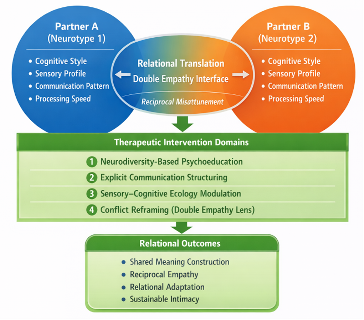
This article presents a conceptual framework for innovative therapeutic interventions for neurodivergent couples through the integration of the neurodiversity approach and the double empathy model. Utilizing an analytical-review methodology, this article systematically examines and synthesizes contemporary interdisciplinary literature on neurodiversity, intimate relationships, autism, ADHD, and couples therapy. The analysis indicates that many relational difficulties in neurodivergent partnerships arise not from unilateral empathic deficits but from reciprocal differences in cognitive processing, communication styles, and sensory experiences. The proposed framework emphasizes four interrelated clinical domains: psychoeducation grounded in neurodiversity principles, explicit communication structuring, sensory environment modulation, and conflict reframing through the lens of the double empathy model. Integrating these perspectives shifts therapeutic focus from correcting individual “deficits” to fostering mutual understanding between differing perceptual and social systems. By promoting reciprocal empathy, relational adaptation, and acceptance of neurological differences, this integrative model offers a transformative direction for couples therapy. The article concludes by outlining implications for therapist training and future empirical research aimed at developing evidence-based protocols tailored to neurodivergent couples.
Downloads
References
Armstrong, T. (2010). Neurodiversity: Discovering the extraordinary gifts of autism, ADHD, dyslexia, and other brain differences. Da Capo Lifelong Books.
Attwood, T. (2006). The complete guide to Asperger's syndrome. Jessica Kingsley Publishers.
Bagatell, N. (2010). From cure to community: Transforming notions of autism. Disability & Society. Retrieved from https://www.jstor.org/stable/40603399
Baron-Cohen, S., Wheelwright, S., & Bullmore, E. (2001). The autism spectrum quotient (AQ): Evidence from Asperger syndrome/high-functioning autism, males and females, scientists and mathematicians. Journal of Autism and Developmental Disorders, 31(1), 5–17.
Botha, M., Dibb, B., & Frost, D. M. (2022). "Autism is me": An investigation of how autistic individuals make sense of autism and stigma. Disability & Society, 37(3), 427–453. https://doi.org/10.1080/09687599.2020.1822782
Chapman, R. (2021). Neurodiversity and the social ecology of mental health. Health, 27(6), 906–923. https://doi.org/10.1177/13634593211039463
Chapman, R., & Botha, M. (2022). Neurodivergence-informed therapy. Developmental Medicine & Child Neurology, 65(3), 310–317. https://doi.org/10.1111/dmcn.15384
Crompton, C. J., Sharp, M., Axbey, H., Fletcher-Watson, S., & Flynn, E. G. (2025). Neurotype-matching, but not being autistic, influences self and observer ratings of interpersonal rapport. Frontiers in Psychology.
De Laet, H., Wiersema, J. R., & Nijhof, A. D. (2022). Adults with autism prefer to communicate with others who also have autism: A mixed-methods study. Autism Research.
den Houting, J. (2019). Neurodiversity: An insider's perspective. Autism, 23(2), 271–273. https://doi.org/10.1177/1362361318820762
DeThorne, L. S. (2020). Revealing the Double Empathy Problem: It's not that autistic people lack empathy. The ASHA Leader.
Efthimiou, T. N., Wilks, C. E., Foster, S., Dodd, M., Sasson, N. J., Ropar, D., Lages, M., Fletcher-Watson, S., & Crompton, C. J. (2025). Social motor synchrony and interactive rapport in autistic, non-autistic, and mixed-neurotype dyads. Autism. https://doi.org/10.1177/13623613251319585
Ekdahl, D. (2024). The double empathy problem and the problem of empathy: Neurodiversifying phenomenology. Disability & Society, 39(10), 2588–2610. https://doi.org/10.1080/09687599.2023.2220180
Foster, S. J., Ackerman, R. A., Wilks, C. E., Dodd, M., Calderon, R., Ropar, D., Fletcher-Watson, S., Crompton, C. J., & Sasson, N. J. (2025). Autism, 29(7), 1700–1710. https://doi.org/10.1177/13623613251320444
Heasman, B., & Gillespie, A. (2018). Neurodivergent intersubjectivity: Distinctive features of how autistic people create shared understanding. Frontiers in Psychology.
Hull, L., Petrides, K. V., Allison, C., Smith, P., Baron-Cohen, S., Lai, M. C., & Mandy, W. (2017). "Putting on my best normal": Social camouflaging in adults with autism spectrum conditions. Journal of Autism and Developmental Disorders, 47(8), 2519–2534. https://doi.org/10.1007/s10803-017-3166-5
HPSS, Vol 2, No 1, pp05_15, Mar 2026
https://doi.org/10.55672/hpss2026pp05_15
A Ghanbari Panah
ISSN: 3115-8625/©2026 Published by Hypersci. Psychol. Soc. Sci
Johnson, S. M. (2019). Attachment theory in practice: Emotionally focused therapy (EFT) with individuals, couples, and families. Guilford Publications.
Kapp, S. K., Gillespie-Lynch, K., Sherman, L. E., & Hutman, T. (2013). Deficit, difference, or both? Autism and neurodiversity. Developmental Psychology, 49(1), 59–71. https://doi.org/10.1037/a0028353
Khalifa, N., Talbot, E. V., & Barber, M. (2022). ADHD in adults and its impact on romantic relationships: A systematic review. Journal of Attention Disorders, 26(8), 1071–1085. https://doi.org/10.1177/10870547211063644
Marsh, L., McGee, E., & Williams, T. (2020). "It's not all bad": The experiences of partners of autistic adults. Autism, 24(7), 1791–1800. https://doi.org/10.1177/1362361320926205
Meyerding, L. (2014). Neurodiverse relationships: Autistic and non-autistic partners share their experiences. CreateSpace Independent Publishing Platform.
Milton, D. E. M. (2012). On the ontological status of autism: The 'double empathy problem'. Disability & Society, 27(6), 883–887. https://doi.org/10.1080/09687599.2012.710008
Milton, D. E. M., Gurbuz, E., & López, B. (2022). The double empathy problem: Ten years on. Autism, 26(8), 1901–1903.
Nimmo-Smith, V., Merwood, A., Hank, D., Brandling, J., Greenwood, R., Skinner, L., Law, S., Patel, V., & Rai, D. (2020). Non-pharmacological interventions for adult ADHD: A systematic review. Psychological Medicine, 50(4), 529–541. https://doi.org/10.1017/S0033291720000069
Robertson, A. E., & Simmons, D. R. (2015). The sensory experiences of adults with autism spectrum disorder: A qualitative analysis. Perception, 44(5), 569–586. https://doi.org/10.1068/p7833
Sasson, N. J., Faso, D. J., Nugent, J., Lovell, S., & Kennedy, D. P. (2017). Neurotypical peers are less willing to interact with those with autism based on thin slice judgments. Scientific Reports, 7(1), 40700. https://doi.org/10.1038/srep40700
Singer, J. (1999). 'Why can't you be normal for once in your life?': From a 'problem with no name' to the emergence of a new category of difference. In M. Corker & S. French (Eds.), Disability Discourse (pp. 59–67). Open University Press.
Walker, N. (2021). Neuroqueer Heresies: Notes on the neurodiversity paradigm, autistic empowerment, and postnormal possibilities. Autonomous Press.
Watts, G., Crompton, C., Grainger, C., Long, J., & Botha, M. (2025). "A certain magic": Autistic adults' experiences of interacting with other autistic people and its relation to quality of life: A systematic review and thematic meta-synthesis. Autism.
Published
How to Cite
Issue
Section
License
Copyright (c) 2026 Hyperscience International Journal

This work is licensed under a Creative Commons Attribution-NonCommercial 4.0 International License.